Efficiency Experts Complete Marathon 547-Day Search for Someone to Make Things Faster
The Search That Outlasted Three Presidential Campaigns
The newly minted Office of Workforce Efficiency (OWE) has achieved what many thought impossible: conducting a hiring process so byzantine that it became a case study in everything the position was created to fix. After 547 days of meticulous deliberation, the committee tasked with streamlining federal recruitment has successfully demonstrated why the federal government struggles to hire a janitor, let alone a senior executive.
The journey began in March 2023 when Congress, in a rare moment of bipartisan agreement, decided the federal hiring process needed someone to make it less terrible. What followed was a masterclass in governmental irony that would make Franz Kafka weep with admiration.
"We knew from day one that this hire had to be perfect," explained Deputy Assistant Administrator for Personnel Optimization Janet Fieldstone, speaking from her office in the Herbert Hoover Federal Building's sub-basement. "You can't just throw any random efficiency expert at a problem this complex. That's why we developed our 94-page application, which really separates the wheat from the chaff."
The Application That Broke Applicants
The application itself became legendary within federal circles, requiring candidates to provide detailed explanations of their philosophy on bureaucracy (minimum 2,000 words), a comprehensive family tree dating back to 1847, and written testimony from two sitting senators confirming the applicant had never expressed frustration with government processes in public.
One particularly ambitious section asked candidates to redesign the federal hiring system while simultaneously explaining why their proposed changes wouldn't work. "It's a trick question," admitted Senior Review Specialist Marcus Pemberton. "Anyone who thinks they can actually fix this system clearly doesn't understand the system."
The requirements proved so daunting that of the initial 847 applicants, only 23 successfully submitted complete applications. Of those, 19 were immediately disqualified for failing to use the correct shade of blue ink (Federal Blue #247, not to be confused with Navy Blue #248 or the now-deprecated Federal Blue #246).
Interview Process Achieves Peak Bureaucracy
The four surviving candidates then faced what officials proudly described as "the most comprehensive interview process in federal history." This involved four separate rounds of interviews conducted in Washington D.C., Denver, and inexplicably, a Holiday Inn conference room in Topeka, Kansas.
"The Topeka interview was crucial," explained Committee Chairwoman Dr. Patricia Windham-Foster. "We needed to see how candidates performed in a completely arbitrary environment that served no logical purpose. It's basically a simulation of working in government."
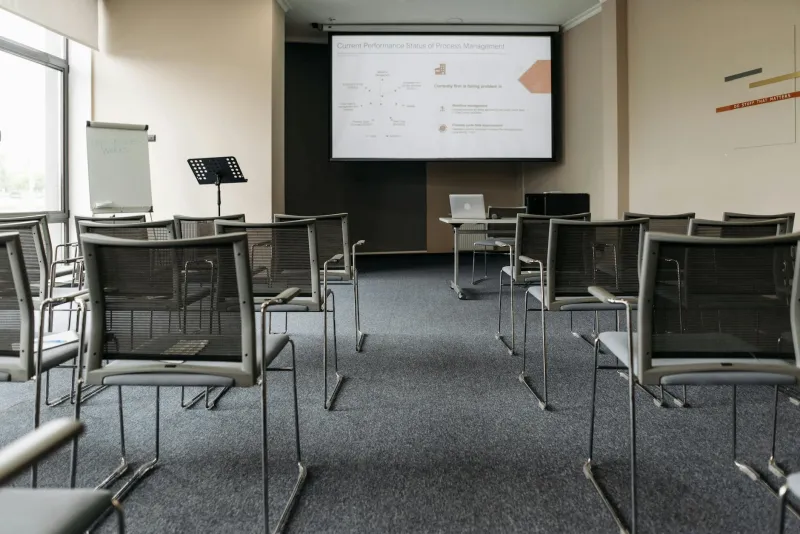
Each interview round required candidates to present detailed PowerPoint presentations on increasingly abstract topics, culminating in a final presentation titled "Synergizing Paradigmatic Approaches to Holistic Process Optimization in Multi-Stakeholder Environments." One candidate reportedly spent six weeks preparing slides that ultimately weren't needed because the projector couldn't be located.
The Committee That Needed a Committee
Perhaps most remarkably, the hiring committee itself required its own hiring committee. The Committee Selection Committee (CSC) spent four months determining who was qualified to select someone to hire someone to fix hiring. This created what organizational psychologists later termed "a perfect bureaucratic ouroboros."
"We couldn't just let anyone pick the people who would pick the person," noted CSC member Dr. Harold Bixby. "That would be chaos. Complete chaos."
The selection process was further complicated when the form used to schedule interviews became subject to the same backlog the new director was being hired to eliminate. This created what officials diplomatically termed "a temporal paradox of administrative efficiency."
Victory Snatched from the Jaws of Victory
After 18 months of rigorous evaluation, the committee unanimously selected Dr. Sarah Chen, a process improvement consultant with 15 years of experience streamlining operations in both public and private sectors. Dr. Chen's innovative proposals for reducing hiring timelines from 18 months to a mere 8-10 months impressed even the most skeptical committee members.
Unfortunately, during the committee's six-week deliberation period following her final interview, Dr. Chen accepted a position as Chief Operations Officer at a Fortune 500 company. Her new role began three days after her federal interview concluded.
"Dr. Chen's departure really validates our thorough approach," reflected Deputy Administrator Fieldstone. "Anyone willing to wait around for our decision-making process clearly lacks the urgency needed for this position."
The Review of the Review Process
The Office of Workforce Efficiency has now formed a special task force to examine why their carefully designed position failed to attract suitable candidates. The Review Committee Review Committee (RCRC) will spend the next 12 months analyzing the hiring process, with findings expected to be ready just in time for the next hiring cycle.
"We're confident that with proper analysis, we can identify exactly why this process took so long and make appropriate adjustments," announced RCRC Chairman Theodore Wainscott. "Of course, those adjustments will need to be reviewed by the Adjustment Review Board, but we're optimistic about completing that process by late 2027."
Meanwhile, the Office of Workforce Efficiency continues operating without a director, which staff members privately admit has significantly improved overall productivity. As one anonymous employee noted, "Turns out the most efficient thing we ever did was fail to hire an efficiency expert."