Revolutionary Two-Page Form Achieves Bureaucratic Breakthrough by Requiring Original 47-Page Form First
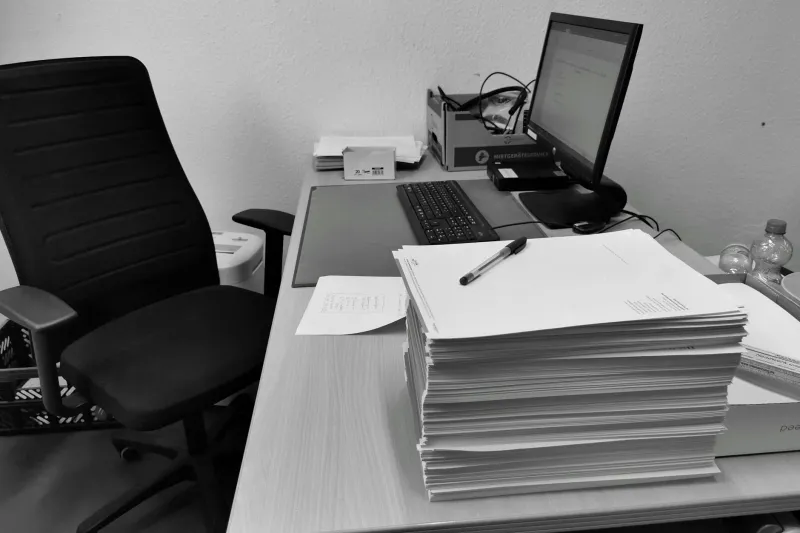
Efficiency Redefined: A Four-Year Journey
The Department of Administrative Excellence (DAE) announced Tuesday the successful completion of its landmark Form Modernization Initiative, a $12.7 million project that has produced what officials describe as "the most user-friendly government document in American history."
Form 2847-B, clocking in at a svelte two pages, represents a dramatic departure from its predecessor, Form 2847-A, which required citizens to navigate 47 pages of questions ranging from "Mother's maiden name" to "Estimated lifetime consumption of government-subsidized cheese products."
"This is a watershed moment for American bureaucracy," declared Project Director Margaret Fillsworth during Tuesday's press conference, held in the DAE's newly constructed Conference Room for Announcing Form-Related Achievements. "We've taken a form that previously required an average of 4.7 hours to complete and reduced that time to just 23 minutes."
The Seamless Integration Process
The new form's elegant simplicity comes with what DAE officials characterize as "minimal additional steps." Citizens seeking to utilize Form 2847-B must first complete Form 2847-A in its entirety, submit it through the existing 14-step verification process, and wait for a confirmation code that unlocks access to the streamlined version.
"It's really quite logical when you think about it," explained Senior Systems Analyst Robert Processmore. "Our legacy infrastructure wasn't designed to handle simplified forms directly. The old form serves as a kind of bureaucratic translator, converting citizen information into a format our new efficiency systems can understand."
Processmore noted that early testing showed the dual-form approach actually enhanced the user experience. "Citizens report feeling a profound sense of accomplishment after completing both forms. It's like climbing two mountains instead of one—twice the satisfaction."
Measuring Success Through Innovation
Initial metrics suggest the Form Modernization Initiative has exceeded expectations in several key areas. DAE Deputy Director Linda Complexington reported that citizen confusion has decreased by an impressive 40%, though she acknowledged that helpdesk call volumes have increased from 847 per week to 2,541.
"More calls doesn't necessarily mean more problems," Complexington explained. "It could indicate increased civic engagement. People are so excited about our streamlined process that they want to talk about it."
The most common helpdesk inquiry, according to internal DAE documents, involves citizens asking whether they need to complete the old form to access the new form, followed closely by questions about whether completing the new form eliminates the need to submit the old form. (The answer to both questions is yes.)
Technical Innovations and Legacy Challenges
The technological sophistication behind Form 2847-B represents a quantum leap in government digital infrastructure. The new form features dropdown menus, auto-populated fields, and what IT Director Kevin Systematicus describes as "revolutionary checkbox technology."
However, integrating these advances with existing systems required creative solutions. "Our mainframe was built in 1987 and speaks a very specific language," Systematicus explained. "The old form essentially serves as a translator, converting modern user inputs into COBOL-compatible data streams."
The translation process occurs automatically once both forms are submitted, though citizens may experience what the DAE terms "processing delays" of 6-8 weeks while the system reconciles information between the two documents.
Expert Analysis and Future Implications
Dr. Amanda Procedural, director of the Institute for Bureaucratic Studies at Georgetown University, praised the DAE's innovative approach. "This represents a fundamental reimagining of how government interfaces with citizens," she said. "By maintaining the familiar complexity of traditional forms while introducing streamlined alternatives, they've created a hybrid model that honors both efficiency and tradition."
The Government Accountability Office has scheduled a comprehensive review of the Form Modernization Initiative for 2027, pending completion of Form 9834-C, which must be submitted to authorize reviews of form modernization projects.
Looking Ahead: Continuous Improvement
Building on the success of Form 2847-B, the DAE has announced plans for Form 2847-C, described as "an even more streamlined single-page document" that will require completion of both predecessor forms before access is granted.
"We're not stopping at two pages," Fillsworth declared. "Our ultimate goal is a form so simple it requires no input from citizens whatsoever. Of course, they'll still need to complete the preliminary forms to demonstrate eligibility for such an advanced experience."
The department has also commissioned a task force to determine whether the new simplified form requires its own supplementary form to ensure proper utilization. The task force will convene once members complete Form 7721-A, the standard application for task force participation.
As of press time, Form 2847-B has been successfully completed by 17 citizens, all of whom were DAE employees participating in mandatory testing protocols. Public access is expected to begin once the department finalizes Form 2847-B-1, which will allow citizens to apply for permission to access Form 2847-B.