Bipartisan Mental Health Bill Receives Standing Ovation, Commemorative Tote Bag, and Immediate Two-Year Silence
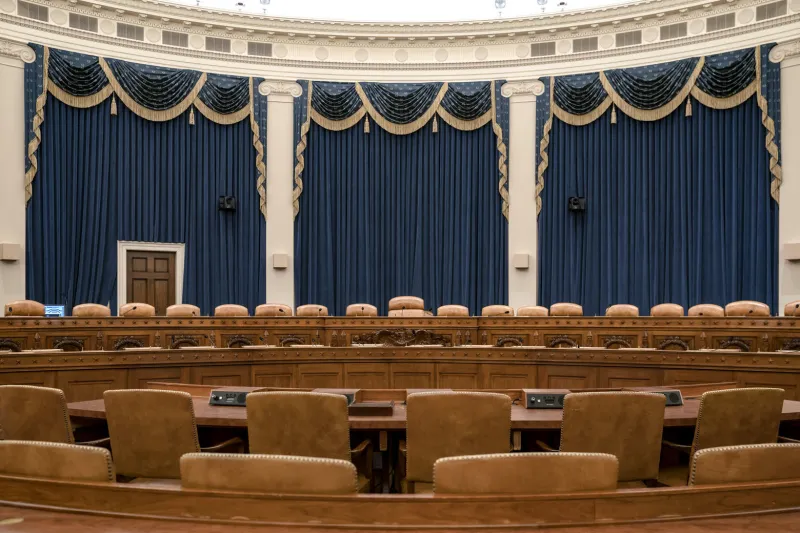
Photo: empty congressional hearing room Capitol Hill subcommittee chamber, via wtop.com
WASHINGTON — In scenes of rare congressional unity, lawmakers from both sides of the aisle gathered on the steps of the Capitol last Tuesday to celebrate the introduction of the Mental Health Access and Awareness for All Americans Act, a sweeping piece of legislation that its sponsors described as "historic," "transformative," and "long overdue" — three words that, in Washington, function primarily as a warning that nothing is about to happen.
The ceremony featured a podium draped in teal ribbon, the official color of mental health awareness, three senators who visibly did not know whose turn it was to speak, and a press release distributed to journalists that was formatted, in its entirety, in 14-point Comic Sans. A spokesperson for the lead sponsor's office confirmed the font choice was "intentional" and "humanizing," before declining to elaborate.
By 9 a.m. the following morning, the bill had been referred to the Subcommittee on Health Policy Jurisdiction Determination, where it has remained, undisturbed, ever since.
The Bill Itself
The Mental Health Access and Awareness for All Americans Act — known in shorthand as MHAAAA, a name that staffers privately admit "doesn't really work as an acronym" — proposes the largest expansion of federal mental health funding in two decades. It would allocate $40 billion over ten years toward community mental health centers, expand insurance parity enforcement, and create a new Office of Mental Health Coordination to, per the bill text, "coordinate the coordination of existing coordination efforts across relevant agencies."
Sponsored jointly by Senator Diane Caldwell (D-OR) and Senator Tom Pryce (R-TX), the bill represents the kind of genuine cross-party collaboration that Washington occasionally produces in the same spirit that a broken clock occasionally tells the correct time.
"Mental health does not care which party you belong to," Senator Caldwell told the assembled crowd, to sustained applause. "It does not care whether you're from a red state or a blue state. It affects every American, in every community, in every corner of this great nation."
Senator Pryce nodded vigorously throughout.
The bill was then sent to a subcommittee that has not held a formal hearing since March of the previous year, whose chairperson is technically on sabbatical, and whose jurisdiction over mental health legislation remains, per the Congressional Research Service, "an open interpretive question."
The Subcommittee Question
The Subcommittee on Health Policy Jurisdiction Determination was established in 2009 to resolve precisely the kind of inter-committee turf disputes that arise when major health legislation is introduced. Its core mandate is to determine which committee or subcommittee has primary jurisdiction over a given bill before routing it appropriately.
Since 2009, the subcommittee has successfully resolved four such disputes. It has been actively deliberating on seventeen others, including a 2014 nutrition labeling bill that members describe as "still quite live."
The central question delaying the Mental Health Access and Awareness for All Americans Act, sources familiar with the subcommittee's internal discussions say, is whether mental health constitutes a federal matter, a state matter, or — and this is the position gaining the most traction in recent months — "a philosophical matter that may fall outside the committee's technical remit."
"We want to get this right," said a spokesperson for subcommittee Chair Representative Alan Marsh (R-KY), who did not make himself available for comment. "The Chair believes strongly that the question of federal versus state jurisdiction in mental health policy is one of the most consequential constitutional questions of our time, and he intends to give it the full deliberation it deserves."
Representative Marsh has not convened a subcommittee meeting since November.
Expert Commentary: The Delay Is the Message
Outside observers have offered a range of interpretations for the bill's apparent hibernation, some more charitable than others.
Dr. Simone Reyes, a health policy analyst at the Georgetown Center for Legislative Outcomes, suggested that the two-year tabling period should not necessarily be read as inaction.
"In a way," Dr. Reyes said, carefully, "one could argue that allowing a mental health bill to sit untouched in a subcommittee for an extended period is itself a form of awareness. The bill exists. It is known to exist. People are aware of it. That's not nothing."
She was then asked whether awareness without action constitutes meaningful policy progress.
"No," she said. "Obviously not. I was being generous."
Professor Harold Stine of the American University School of Public Affairs took a more structural view, noting that the pattern of enthusiastic introduction followed by extended subcommittee silence is "essentially the default lifecycle of health legislation in this Congress" and that the Mental Health Act was, if anything, receiving above-average attention by virtue of having a known subcommittee location.
"Some bills," Professor Stine noted, "we genuinely cannot find."
The Ribbon Ceremony: A Retrospective
For many observers, the most durable legacy of the bill's introduction may be the ceremony itself, which is being quietly cited in political communications circles as a case study in the art of the announcement-as-substitute-for-action.
In addition to the teal ribbon and Comic Sans press release, the event featured a commemorative tote bag distributed to attendees bearing the bill's full title and the phrase "Because Mental Health Matters" above a small graphic of a brain wearing a hard hat — an image that, a spokesperson confirmed, was selected after "significant internal discussion" and was meant to convey "resilience."
A short video package was also released across the sponsors' social media channels, set to an acoustic guitar instrumental, showing slow-motion footage of the two senators shaking hands, walking through a sunlit hallway, and pointing at a whiteboard. The whiteboard was blank. The video has 340,000 views.
The bill has zero scheduled hearings.
Where Things Stand
As of publication, the Mental Health Access and Awareness for All Americans Act remains in the Subcommittee on Health Policy Jurisdiction Determination, where it joins a growing portfolio of legislation awaiting jurisdictional clarity. A spokesperson for Senator Caldwell's office confirmed that the Senator "remains committed to the bill's passage" and is "actively engaged in conversations with colleagues about a path forward."
Senator Pryce's office issued a statement saying the Senator "continues to believe mental health is an important issue."
The subcommittee has not responded to requests for comment, a scheduling update, or confirmation that it is currently operational.
Mental health advocates say they will continue pushing for action, though several noted, with what one described as "a certain irony," that navigating the legislative process on behalf of a mental health bill has itself become a significant source of stress.
"We're fine," said one advocate, who asked not to be named. "We have the tote bag. It's a good tote bag."
The subcommittee is expected to meet sometime before the midterms, though which midterms has not been specified.