Official Congressional Productivity Audit Confirms Legislature's Signature Accomplishment Was Picking a Vacation Date

Official Congressional Productivity Audit Confirms Legislature's Signature Accomplishment Was Picking a Vacation Date
WASHINGTON — A comprehensive productivity assessment of the current Senate session, released Thursday by the Office of Legislative Metrics and Procedural Accountability, has determined that the United States Senate's most tangible, fully bipartisan, and successfully completed act of governance this term was the unanimous passage of Senate Resolution 114-B: A Resolution Confirming the Commencement Date of the Upcoming District Work Period.
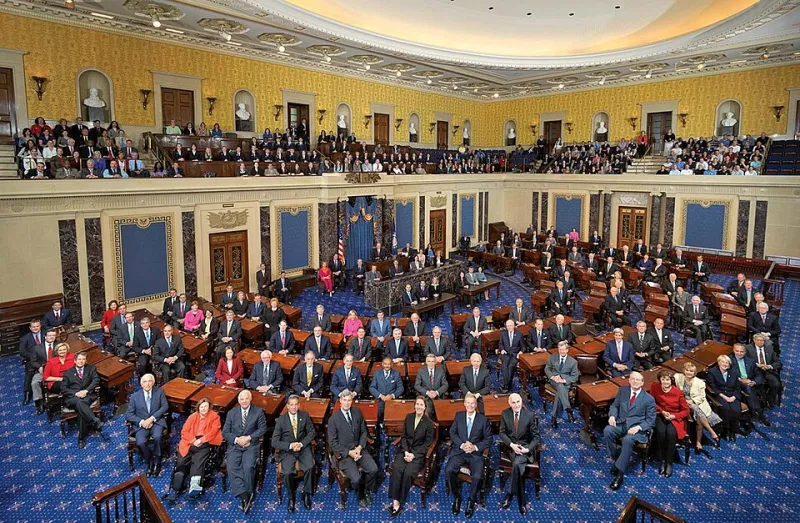
 Photo: United States Senate, via c8.alamy.com
The resolution, which established that senators would begin their recess on a date that the calendar had already independently confirmed, passed 97-0 in under four minutes — a speed that congressional observers noted has not been matched by any other piece of legislation this session, or indeed during several preceding ones.
"We are enormously proud of what this chamber accomplished," said Senate Majority Spokesperson Patricia Dunmore at a press briefing convened specifically to discuss the report. "When you look at the totality of legislative activity — the hearings convened, the subcommittees mobilized, the floor time allocated — what you see is an institution that knows how to get things done when it really, truly needs to."
She did not elaborate on why the institution had needed to formally vote on a date that was already printed on laminated calendars distributed to every member's office in January.
A Thorough Accounting of Absolutely Everything Else
The 340-page productivity report, which took eleven months to compile and was itself the subject of a scheduling dispute, provides a detailed breakdown of legislative activity across all standing committees. The results are, according to the report's own executive summary, "a nuanced picture of deliberative democracy in motion."
The Senate Committee on Finance held 23 hearings, produced four interim reports on the need for additional hearings, and advanced zero bills to the floor.
The Select Subcommittee on Regulatory Modernization convened seventeen times, commissioned a $400,000 external review of its own procedural framework, and released a 90-page document recommending the formation of a working group to assess whether the subcommittee's mandate required updating. The working group has not yet met, pending confirmation of a chair.
The Joint Bipartisan Task Force on Legislative Efficiency — established in a prior session specifically to identify and eliminate procedural bottlenecks — spent the majority of this term debating its own terms of reference, ultimately tabling a final report until "conditions allow for a more complete picture to emerge."
The Committee on Commerce, Science, and Transportation scheduled eleven votes. Eight were postponed to allow for additional member consultations. Two were rescheduled to discuss when the rescheduled votes might occur. One was held, and concerned the renaming of a conference room in the Dirksen Senate Office Building.
Press Releases as Legislative Output
The report notes, with apparent sincerity, that Senate offices collectively issued 4,847 press releases during the session — a figure described in the document as evidence of "robust public communication and sustained member engagement with the issues facing American families."
Of these, 1,203 announced the introduction of bills that did not receive committee hearings. Another 892 expressed strong concern about issues on which no corresponding legislation was introduced. Four hundred and seventeen celebrated the anniversaries of previous press releases about legislative priorities that remain unaddressed.
"A press release is not nothing," said Dr. Harold Fenwick of the Brookings-Adjacent Center for Democratic Process Studies, when reached for comment. "It represents a senator's office spending approximately forty-five minutes articulating a position. That is forty-five minutes of democratic engagement. You cannot simply dismiss that."
Dr. Fenwick then paused for a long time before adding that he was, professionally speaking, trying very hard.
The Recess Resolution: An In-Depth Analysis
Congressional historians have noted that the recess date resolution is, by measurable standards, the most efficiently processed piece of Senate business in recent memory. From introduction to passage, the entire process took six days — a legislative sprint that left veteran staffers visibly moved.
"There was real momentum in that chamber," said one senior aide, who requested anonymity because their senator had not yet issued a press release about the recess. "You could feel it. People wanted this done. People were unified around this."
The resolution itself runs to four paragraphs. It acknowledges that members have district obligations. It notes that constituent engagement is a cornerstone of representative democracy. It resolves, with the full authority of the United States Senate, that the recess shall begin on a Tuesday.
It is the only piece of legislation this session to have been described, by three separate members, as "long overdue."
Expert Commentary
Dr. Susan Albrecht, a senior fellow at the Institute for Legislative Performance and Governance Benchmarking, reviewed the full report and offered the following assessment:
"What we're seeing here is an institution that has successfully identified the one area where consensus was achievable and pursued it with genuine commitment. The recess date resolution represents meaningful forward momentum for the institution. In the current environment, you take what you can get."
She submitted her commentary via a form on the Institute's website, which auto-generated a response informing her that her input had been received and would be reviewed within six to eight weeks.
What Comes Next
Senate leadership confirmed Thursday that the chamber will reconvene following the recess with a packed agenda that includes, according to a preliminary schedule, four hearings on issues previously discussed in hearings, two votes on procedural motions related to a bill that has not yet been introduced, and an organizational meeting for a new Select Committee on Congressional Productivity whose mandate, terms of reference, and membership are still being negotiated.
A spokesperson confirmed that the committee's first order of business will be to agree on a meeting schedule.
The next productivity report is expected in eleven months, or possibly fourteen, depending on when the Office of Legislative Metrics and Procedural Accountability can find a window in its calendar. A press release announcing the report's forthcoming release is expected imminently.