Landmark Simplification Bill Arrives at 900 Pages, Senators Broadly Supportive of Owning a Copy
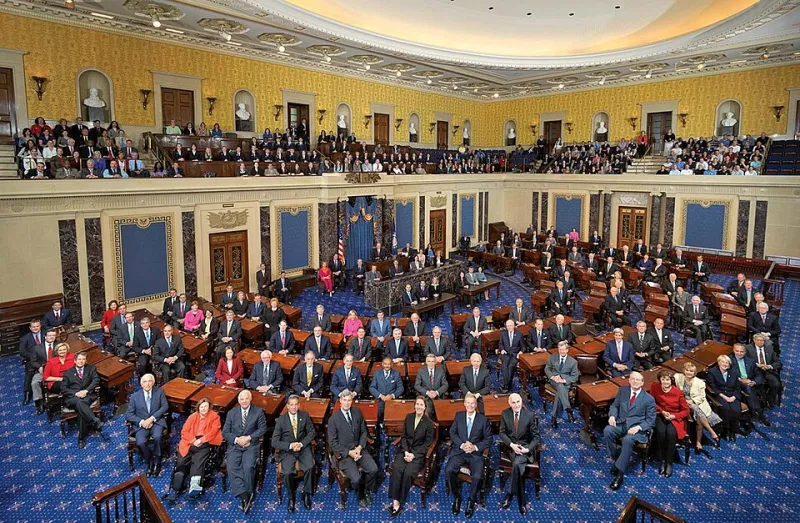
Photo: U.S. Senate, 111th Congress, Senate Photo Studio, Public domain, via Wikimedia Commons
Senator Dale Whitmore (D-OH), a man who has spent eleven years in Congress expressing concern about congressional complexity, introduced the Simplification and Clarity in Governance Act on Monday to what colleagues described as enthusiastic bipartisan applause, a standing ovation, and a collective, unspoken agreement not to read it.
 Photo: Senator Dale Whitmore, via i.ytimg.com
The bill, which Whitmore's office describes as "a bold 47-point framework for streamlining American legislative procedure," runs to 912 pages in its printed form, making it the longest piece of legislation introduced in this session of Congress and, according to three separate legal scholars contacted by this publication, the most structurally unusual document any of them had encountered in their professional lives.
"I've reviewed a lot of legislation," said Professor Anne Calloway of Georgetown Law, who was sent the bill at 9 a.m. and spoke to us at 9:47 a.m. "I've reached page three. It's very dense. The table of contents alone is forty-one pages, which I think technically qualifies as a short bill in its own right."
 Photo: Georgetown Law, via c8.alamy.com
What the Bill Does (In Theory)
According to a two-page summary distributed by Whitmore's communications team — a summary which, the senator's office confirmed, was itself produced before the full bill was finalized — the Simplification and Clarity in Governance Act seeks to reduce the number of redundant federal forms by 30 percent, consolidate seventeen overlapping regulatory review processes into one unified framework, and mandate that all future legislation include an executive summary of no more than four pages.
The bill's executive summary is eleven pages.
Subsection 4(b)(iii) of Title II, one of the six staffers present at Monday's press briefing confirmed they had located, establishes a new Office of Legislative Clarity, which will be responsible for reviewing all bills introduced in Congress for unnecessary complexity. The Office will produce annual reports on its findings. The section establishing the reporting requirements for those annual reports runs to thirty-eight pages.
"We are enormously proud of the architecture of this legislation," said Whitmore's chief of staff, Marcus Brenn, who described himself as "broadly across the key concepts" when asked whether he had read it in full. "The senator has been working on this for three years. A lot of thought has gone into it. A tremendous amount of thought."
When asked who had written the bill, Brenn confirmed it had been drafted by a team of fourteen legislative counsels, two external law firms, and a contractor specializing in regulatory consolidation, none of whom, he acknowledged, had worked from a shared outline.
Bipartisan Support, Loosely Defined
The bill has attracted seventeen co-sponsors from both parties, a fact Whitmore's office described as historic. Several of those co-sponsors, reached for comment, offered assessments that suggested their familiarity with the legislation was largely ceremonial.
Senator Patricia Voss (R-TX), the bill's lead Republican co-sponsor, called it "a common-sense step toward the kind of government Americans deserve" and confirmed she had read the executive summary and "portions of Part One." Part One ends on page 87.
Senator Greg Mullins (D-WA), co-sponsor number seven, said he was "very supportive of the general direction" and had been briefed by staff, adding: "I understand there's a section on forms. I'm in favor of that section."
A spokesperson for Senator Voss later clarified that the Senator had in fact read the two-page summary produced by Whitmore's office and not the eleven-page executive summary contained within the bill itself, and that these were, she confirmed when pressed, different documents.
The Expert Panel
A roundtable convened by the Brookings-adjacent Institute for Legislative Efficiency on Tuesday brought together five policy scholars to assess the bill's prospects. All five described it as ambitious. None had passed page three.
 Photo: Brookings-adjacent Institute for Legislative Efficiency, via c8.alamy.com
"What Senator Whitmore is attempting here is genuinely important," said Dr. Richard Fallow, the panel's moderator, who had been provided the bill the previous evening. "The question of whether Congress can legislate its own simplification is one of the great structural puzzles of modern governance. I look forward to engaging with the text more fully once I've located it. The PDF appears to be non-searchable."
A second panelist, Dr. Carla Simms, noted that the bill's index listed 2,300 defined terms, which she described as "on the high end for simplification legislation" before acknowledging she had identified this by reading the index rather than the bill.
The panel concluded with a joint statement expressing strong support for the bill's objectives and a unanimous recommendation that a summary be produced.
The Summary Subcommittee
Senate leadership announced Wednesday that a subcommittee had been formed to produce a condensed brief of the Simplification and Clarity in Governance Act, targeted at two pages, which could be distributed to members before the vote currently scheduled for Thursday.
The subcommittee has seven members. It met for the first time Wednesday afternoon and spent the session debating its own terms of reference, which had been drafted by Whitmore's office and ran to fourteen pages.
A second subcommittee, sources confirmed, has been proposed to summarize the first subcommittee's brief once produced.
The vote is expected Thursday. Senator Whitmore, asked whether he was confident his colleagues understood what they would be voting for, smiled in the manner of a man who has spent eleven years in the United States Senate.
"Absolutely," he said. "They understand the concept. And in this institution, that's usually enough."